
What It Means to Glorify God and Why It Matters
Discover the one purpose every person was created for and why it changes everything about how you live, work, and worship.

Every person alive is living for something. Some live for money. Some live for pleasure. Some live for the approval of others. But very few stop to ask the question that matters most: What am I actually here for?
The seventeenth-century Puritan pastor Thomas Watson answered that question with a clarity that has not been improved upon in three hundred years. Drawing from the Westminster Shorter Catechism, Watson taught that the chief end of every human being is to glorify God and enjoy Him forever. These are not two separate goals. They are one life, rightly lived. Watson then spent the rest of his exposition showing what this looks like in practice, and his teaching remains as sturdy and searching today as when he first set it down.
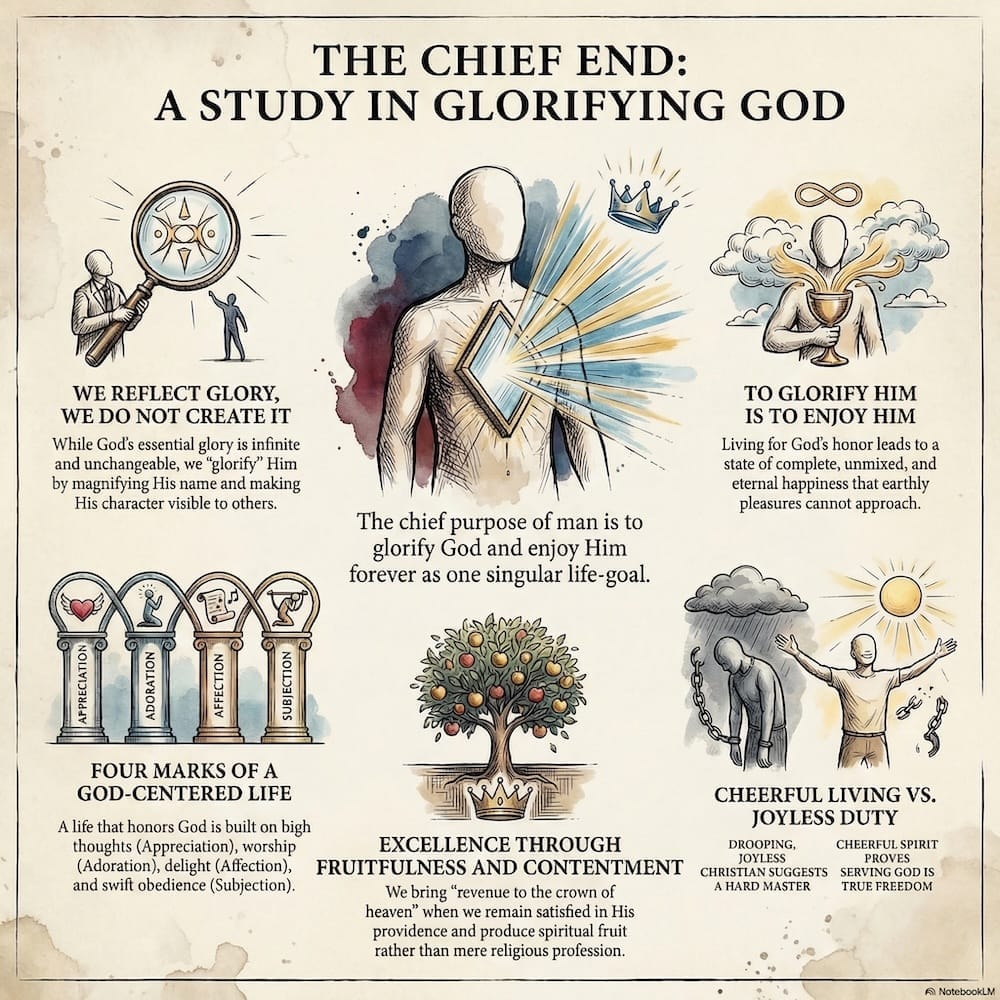
God's Glory Is Not Something We Create
Before we can glorify God, we need to understand what God's glory actually is. There are two kinds. The first is God's intrinsic glory. This is the glory that belongs to God by nature. It is essential to who He is. A king can remove his crown and still be a man. But God cannot be God without His glory. His very life, as it were, lies in it.
This glory cannot be increased. It is already infinite. God will share many things with His people. He will give them wisdom, grace, love, and even heaven itself. But His essential glory He will not give to another. He said so plainly in Isaiah 48:11.
The second kind of glory is the glory we ascribe to God. This is what it means to glorify Him. We do not add anything to God. We lift up His name. We magnify Him in the eyes of others. We live in such a way that people see who He is through what we do.
Four Marks of a Life That Glorifies God
What does it look like to glorify God? It begins with appreciation. To glorify God is to set Him highest in our thoughts, to see Him as the most excellent being in existence. We admire Him in His attributes, His promises, and the works of His hands. We search for diamonds only in this rock.
Second, glorifying God involves adoration. This is worship, and God is jealous over it. Worship must be offered on God's terms, not ours. He is precise about how He is to be approached. The tabernacle was to be built according to the exact pattern given on the mountain. If God was that exact about the place of worship, He will be even more exact about the substance of it.
Third, glorifying God involves affection. God counts Himself glorified when He is loved. Not a self-serving love that merely appreciates His blessings, but a delighting love that treasures God Himself above everything He gives. True love for God is exuberant, superlative, and intense. It gives God the best, not the leftovers.
Fourth, glorifying God involves subjection. This means dedicating ourselves to His service and standing ready for His commands. The angels glorify God this way. They wait on His throne and are swift to obey. We glorify God when our heads study for Him, our tongues speak for Him, and our hands serve His people.
Why Every Person Owes God Glory
The reasons are plain. God gives us our being. We draw every breath from Him. Every comfort we enjoy comes from His hand. Since everything we receive flows from His bounty, it is only right that we live for Him.
God also made all things for His own glory. He will have glory from every creature. He will have glory from the wicked through His justice. He will have glory from the godly through their praise. The saints are the living instruments of His praise, formed for this very purpose.
And God's glory has such surpassing worth that it transcends everything else. It is more valuable than heaven. It is more valuable than the salvation of every human soul. Better that kingdoms fall than that God lose one beam of His glory. That is how precious it is.
Even the creatures below us bring God glory. The heavens declare it. The birds sing it. The beasts honor Him in their own way. The angels above us worship continually. If every other creature glorifies God, what excuse do we have for sitting idle?
Seventeen Ways to Live for God's Glory
The practical applications are many, and each one presses into everyday life.
We glorify God when we aim purely at His glory, preferring it above our own reputation, comfort, and plans. The test is simple: Can you be content for God's will to take place even when it crosses yours?
We glorify God by honest confession of sin. An open, unforced confession exalts God's grace. It acknowledges that He is holy and righteous in whatever He does. Minimizing sin dishonors Him. Owning it brings Him glory.
We glorify God by believing His promises. Faith honors God because it declares Him trustworthy. Unbelief calls God a liar. Abraham was strong in faith, giving glory to God. He trusted where he could not see, and God honored that trust.
We glorify God by being tender of His honor. When His name is dishonored, we feel it as though we ourselves were dishonored. His glory is as precious to us as the apple of His eye.
We glorify God by fruitfulness. It is not profession that honors God, but fruit. A vineyard is planted to produce grapes, not just leaves. God expects spiritual fruit from His people, and the more fruit we bear, the more glory He receives.
Contentment, Cheerfulness, and Costly Obedience
We glorify God by being content in whatever state His providence has placed us. When a Christian can say, "God has put me here, and He has done it in wisdom and love, and I will sit down satisfied," that brings immense glory to God. It shows the watching world that God Himself is enough.
We glorify God by walking cheerfully. When the world sees a Christian who has inward joy even in hard times, it is a powerful testimony. A drooping, joyless Christian gives the impression that God is a hard master. But a cheerful Christian proves that God's service is not bondage. It is freedom.
We glorify God by standing firm for His truth. Much of God's glory lies in His truth, and He has entrusted us with it. When truth comes under attack, the Christian contends for it, not for trifles or secondary opinions, but for the faith once delivered to the saints.
We glorify God by praising Him. Praise is the highest and purest act of religion. In prayer we act like men. In praise we act like angels. Yet how few Christians take up this instrument. Many carry complaints in their mouths, but few carry harps in their hands.
We glorify God by holy living. A consistent, Bible-shaped life adorns the gospel in ways that words alone cannot. When the saints cast a sparkling luster of holiness before the watching world, they bring revenue to the crown of heaven.
And we glorify God by suffering for His sake, if He calls us to it. God's glory shines in the ashes of His martyrs. The early church did not advance by worldly power. It advanced through the cheerful willingness of God's people to lose everything for His name.
The Danger of Living Without This Purpose
If glorifying God is our chief end, then failing to glorify Him is the most dangerous way to live. Many people would never say with their lips that there is no God. But they say it every day with their choices. They live as though no one is watching, as though no accounting will ever come.
God will call every person to account. He has entrusted each of us with health, gifts, time, and opportunities. The parable of the talents makes this clear. It is not enough to say you have not dishonored God. The question is: What glory have you brought to Him? The servant who buried his talent was not accused of wickedness. He was accused of uselessness. And he was cast into outer darkness.
Others go further. They do not merely neglect God's glory. They rob Him of it. They take credit for what God has given. They perform religious duties to be seen by men. They hinder the preaching of God's Word, which is the very instrument by which He saves souls. These will face a severe reckoning.
The Joy That Awaits Those Who Live for God
But there is a far better word than warning. Those who glorify God in this life will enjoy Him forever in the next. These two things are chained together. By raising God's glory, we increase our own. By glorifying Him, we come at last to the blessed experience of enjoying Him without end.
To enjoy God forever is to be placed in a state of complete happiness. God is a universal good, containing all excellencies in Himself. He is an unmixed good, with no drop of bitterness. He is a satisfying good, filling the soul without ever producing weariness. He is a delightful good, ravishing the heart with pleasures that no earthly experience can approach. And He is an eternal good. The joy He gives will never fade, never diminish, and never end.
This is what we were made for. Not to accumulate wealth or pursue pleasure or win the admiration of others. We were made to glorify the God who made us, and to find in Him a joy that outlasts the world.
Thomas Watson pressed this truth into the conscience of his readers three centuries ago, and it has lost none of its force. The arguments against God have not grown stronger. The evidence for Him has not grown weaker. And the invitation still stands. There is a God. He is worthy of all glory. And the soul that lives for His honor will find, in the end, that it has gained everything worth having.
Bibliography
Watson, Thomas. The Select Works of the Rev. Thomas Watson, Comprising His Celebrated Body of Divinity, in a Series of Lectures on the Shorter Catechism, and Various Sermons and Treatises. New York: Robert Carter & Brothers, 1855.
Short Biography of Thomas Watson
Thomas Watson, likely born in Yorkshire, studied at Emmanuel College, Cambridge, earning his BA (1639) and MA (1642). He served at St. Stephen's, Walbrook, London, as lecturer and rector for sixteen years. A committed Presbyterian with royalist sympathies, Watson was imprisoned in 1651 for plotting to restore the monarchy but was released after petitioning for mercy. Ejected from his pastorate under the 1662 Act of Uniformity, he continued preaching privately and later at Crosby Hall, Bishopsgate. He retired to Barnston, Essex, where he died suddenly in 1686 while in prayer. His writings remain widely read today.
Bibliography
- The CSB Study Bible. Edited by Trevin Wax and Andy McLean. Nashville: Holman Bible Publishers, 2017.
- Ryken, Leland, and Philip Graham Ryken, eds. ESV Literary Study Bible. Wheaton, IL: Crossway, 2019.
- ESV Study Bible. Edited by Lane T. Dennis and Wayne Grudem. Wheaton, IL: Crossway Bibles, 2008.
- The MacArthur Study Bible. Edited by John MacArthur. Nashville: Thomas Nelson, 1997.
- NIV Biblical Theology Study Bible. Edited by D. A. Carson. Grand Rapids: Zondervan, 2018.
- Reformation Heritage KJV Study Bible. Edited by Joel R. Beeke. Grand Rapids: Reformation Heritage Books, 2014.
- The Reformation Study Bible. Edited by R. C. Sproul. English Standard Version. Orlando, FL: Reformation Trust Publishing, 2015.



Comments ()