
The Parable of the Sower Explained (Mark 4:1–20)
Why do some people hear God's word and change, while others don't? Jesus answers this in Mark 4 — and the answer depends entirely on God.
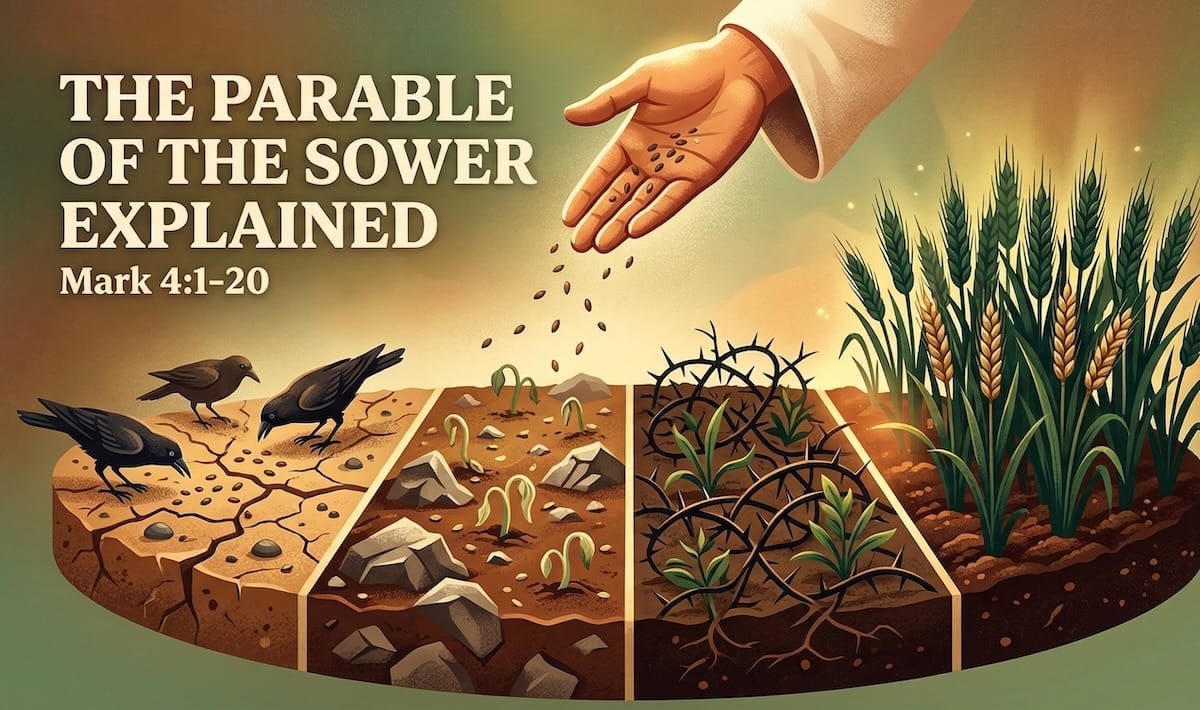
Two people can sit in the same church pew, hear the same sermon, and walk out completely differently. One is transformed. The other is untouched. Same preacher. Same words. Same room.
Why?
Jesus answered this question directly in the parable of the sower (Mark 4:1–20). And His answer is both humbling and deeply comforting.
Jesus Said: "Listen"
Before telling the parable, Jesus used a single imperative word: "Listen." That's not a throwaway opener. It's a deliberate signal. What follows demands careful attention.
A farmer went out to sow seed. Some fell on a hardened path and birds ate it. Some fell on rocky ground, sprouted quickly, then withered under the heat. Some fell among thorns and was choked out before it could mature. And some fell on good soil and produced a remarkable harvest: thirty, sixty, even a hundredfold.
In first-century Palestine, sowing came before plowing. Paths worn down by foot traffic were never plowed, so seed that landed there had no chance. Rocky patches hidden under thin topsoil only became visible after the plow turned the ground. The point is not that the sower was careless. The point is that the soil was simply unprepared to receive the seed.
After the parable, Jesus added this: "He who has ears to hear, let him hear." It's a call for honest self-examination.
The Problem Is Deeper Than Willpower
When Jesus explained the parable privately to His disciples, He said something striking: "To you has been given the mystery of the kingdom of God, but to those who are outside, everything comes in parables" (v. 11).
Insiders received understanding. Outsiders received only riddles. And notice: this understanding was given. It was not earned through effort or intelligence.
Paul made the same point plainly: "A natural man does not accept the depths of the Spirit of God, for they are foolishness to him, and he cannot understand them, because they are spiritually examined" (1 Cor. 2:14). The unregenerate mind is not just unwilling to receive God's word. It is unable.
This means that simply trying harder to understand the Bible is not the answer. The human mind, left to itself, cannot grasp the things of God. Something must happen first. The Holy Spirit must open the eyes.
Jesus promised exactly this: "But when He, the Spirit of truth, comes, He will guide you into all the truth" (John 16:13).
This is what theologians call illumination. It is the Holy Spirit's work of opening the mind to see what Scripture actually says and means. Without it, the Bible stays closed. Not because the words are unclear, but because the reader is spiritually blind. With it, a person can read a passage they've seen a dozen times and suddenly understand it in a way that changes them.
This is why we pray before reading Scripture. It is not a formality. It is an acknowledgment that we need God to open our eyes.
Three Dangers That Choke Out the Word
God must do a second work in us as well. He must preserve what He has planted.
In Jesus' explanation of the parable, the word fails to bear fruit in three of the four soil types. Each failure has a different cause.
The first danger is Satan. When the seed falls on the hardened path, the enemy comes immediately and takes it away (v. 15). The word never gets a foothold.
The second danger is affliction and persecution. The rocky-ground hearer responds to the word with joy, but when life gets hard, he falls away (vv. 16–17). His roots were shallow. Suffering exposed that.
The third danger is the pull of the world. The thorny-ground hearer is not persecuted. He is simply distracted. The worries of life, the deceit of wealth, and the desire for other things gradually crowd out the word until it bears nothing (vv. 18–19).
These three dangers are not ancient. Every serious Christian today faces all three.
So how does anyone persevere? Left to ourselves, we would not. But Jesus made a promise that has no exceptions: "I give eternal life to them, and they will never perish—ever; and no one will snatch them out of My hand. My Father, who has given them to Me, is greater than all; and no one is able to snatch them out of the Father's hand" (John 10:28–29).
That is a total guarantee. Satan cannot snatch you away. Suffering cannot snatch you away. The world's distractions, as powerful as they feel in the moment, cannot pull you out of the Father's hand.
God preserves what He plants.
The Soil Is in God's Hands
The difference between good soil and bad soil is not found in us. It is found in God.
We did not open our own eyes to the truth of Scripture. We did not secure our own salvation. We did not keep ourselves from falling away by our own resolve. It is God who illuminated our hearts, and it is God who preserves us to the end.
That is not a reason for passivity. We still read. We still pray. We still place ourselves under faithful preaching and guard against what competes for our hearts. But we do all of this knowing that we are not holding ourselves in God's hand. He is holding us in His.
Jude captured it simply: God is "able to keep you from stumbling, and to make you stand in the presence of His glory blameless with great joy" (Jude 19).
Rest in that today. The condition of your soil is in the hands of a faithful God, and He will not let go.


Comments ()