
A Letter to My Six-Year-Old Son with Autism
A letter written by a father after his autistic son's sixth birthday, intended to encourage his son to trust God's greatness and goodness.
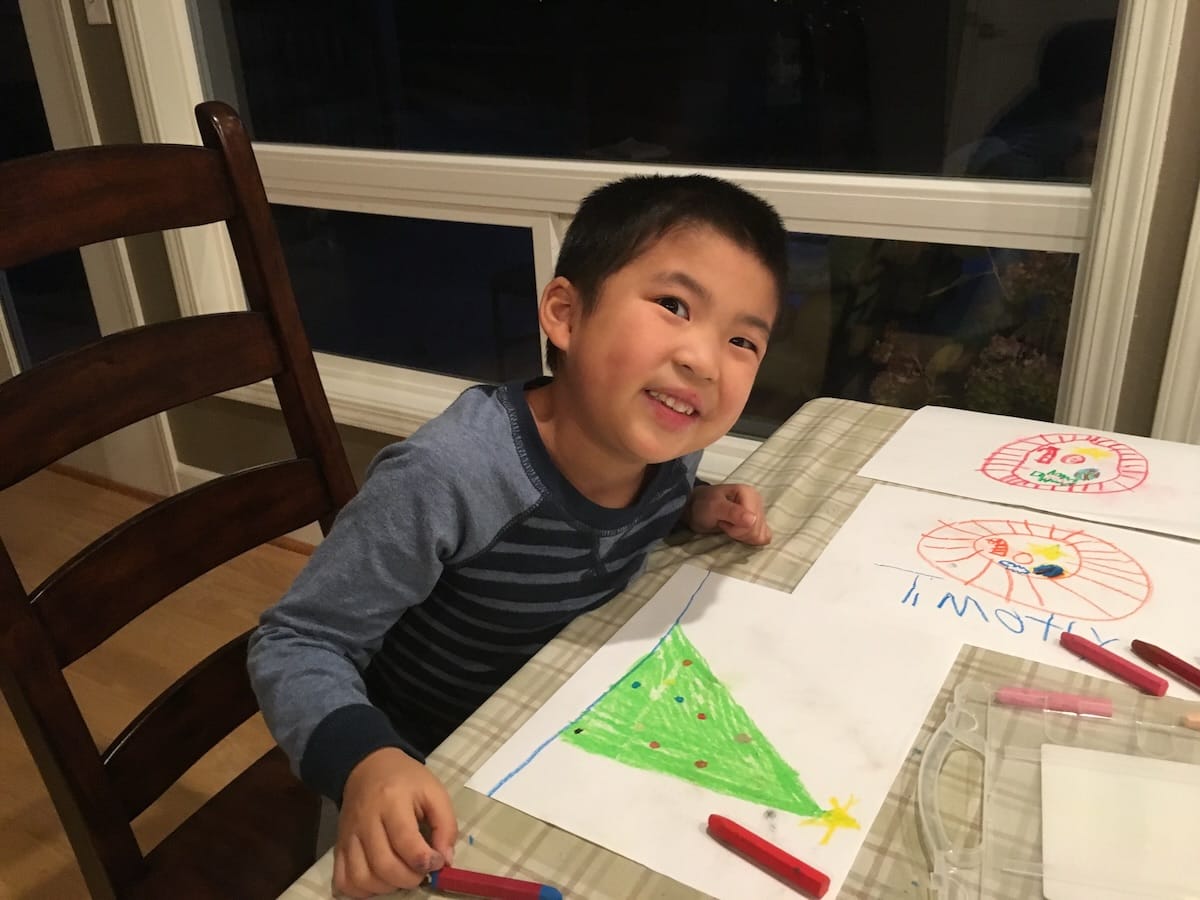
Timothy, I wrote this letter shortly after your sixth birthday. God gave you a challenge that no parent ever wishes for their child. I hope that one day, when you read this, it will encourage you to continue to overcome.
Dear Timothy,
I look back on your early years with great fondness. Since you won’t remember many details of your childhood, I wrote this letter to remind you that our God is great and good.
First–Time Parents with Big Dreams
As new parents, Mommy and I were clueless. Before you were born, I asked a police officer to install your car seat. We adhered to a rigid nursing and sleep schedule, and for months, we swaddled you tightly to a wedge to help you sleep.
Mommy and I wanted to do everything right. We attended parenting classes, researched blogs, and read books. We believed if we parented you correctly, you would grow up wonderfully.
We were exhausted those first months, but every moment with you was precious. I loved holding you against my chest skin–to–skin. Nightly, I hummed the tune to “Everybody Loves Raymond” to rock you to sleep. Whenever I saw your chubby cheeks and dimpled smile, I daydreamed about your bright future.
Adorable Idiosyncrasies
As an infant, you exhibited several strange habits. For example, you avoided touching anything with texture. You never dared to walk barefoot on grass or sand and never wanted your feet or hands dirty. Any food particle stuck on your hands would make you cry.
When you were nine months old, you loved to watch objects spin. You flipped your cars, trucks, and toy vehicles upside–down to spin their wheels and watch them rotate. Instead of playing with life-size blocks or other fun toys at one local indoor playground, you spun these little flower wheels on the wall and stared as they twirled. Left to yourself, you would spin these flowers all day.
You enjoyed arranging your toy cars in a straight line every day. Sometimes, I would provoke you by adjusting one of your cars slightly off–angle. Without delay, you would reposition the car back to its original alignment.
You resisted all change. While driving to a restaurant one day, we took a different route. Seconds after I made the detour, you started to cry. Whenever we took an unfamiliar path, you became agitated. You thought we were going the wrong way. So, to appease you, we had to drive to every destination using the same route.
You met your developmental milestones during your first year of life with two notable exceptions. First, you never learned to wave hello or goodbye. Friends and relatives would wave to you, but you never reciprocated. Second, you never said “mama” or “mommy.” Mommy cared for you 24 hours a day, yet you never called her by name. This made Mommy a little sad.
When we brought Titus home from the hospital, you were 13 months old. After some adjustment, you embraced your little brother with welcomed arms. Seeing you doting on him and watching him giggle back at you, Mommy and I felt that God had given us the perfect family. That feeling, however, was short–lived.
Watching You Slip Away
Even at 18 months, you never responded when Mommy and I called your name, “Timothy.” We had expected you would walk over to us when we called for you. One afternoon, Mommy raised her voice to get your attention. Even five-month-old Titus gave Mommy a confused look, wondering why you were not responding. We questioned if you had trouble hearing.
Soon, you started to stare away blankly. At first, it was a few seconds before you resumed eye contact with us. But gradually, your spells grew longer. Sometimes, you would stare off for 60 seconds; even if we waved our hands toward your face to grab your attention, your eyes would not follow.
Over the next two weeks, you began to lose your speech and stopped vocalizing words you had learned. Even though I knew it wasn’t your fault, I once exploded, “Why are you doing this, Timothy?” Feeling scared, you started flapping your arms.
I was confused. I didn’t know what we were doing wrong. Did we feed you the wrong types of food? Were we being too strict with you? Was it because of a vaccine or medication we had given to you? We didn’t have an answer.
What we did know was we were losing you. You were losing your ability to hear, look at, and talk to us. You were slipping away.
During one car ride, like an avalanche, the realization of your regression overwhelmed me. While driving, I started sobbing. In complete despair, I asked God, “Why are you taking away my son?”
The Scramble For Help
At first, we didn’t know what to do. Should we call the doctor? Should we contact the school district? You were only 19 months old, and most public schools did not provide services for children under 3 years old.
After researching online, we learned that the Regional Center of the East Bay supports young children with developmental disabilities. We scheduled a phone interview, but the appointment we were given remained four weeks away.
Our local school district had a unique program called SITES. SITES was an early start program for infants and toddlers with development delays. They provided education, counseling, and services through a team of teachers, occupational and physical therapists, and psychologists. When we called them, they offered us an appointment the following week.
With Mommy and me by your side, you completed a three-hour assessment conducted by the SITES team. The next day, the lead teacher informed us that they had accepted you into their program and wanted you to start immediately.
So, with Titus, Mommy brought you to SITES two mornings a week. In every class, you were placed in a sandbox full of dry beans to challenge your sensory input. Using your mouth, you sampled mustard, lemon juice, and different flavors and textures with great displeasure. You completed activities led by speech and occupational therapists who worked on your gross and fine motor skills.
After three weeks, one psychologist from the SITES team asked Mommy if we were concerned that you might have autism. That was the first mention of autism and autistic spectrum disorder (ASD). Mommy replied that we were not worried. We thought you just needed help to pay attention, maintain eye contact, and re–learn your words.
Evaluation for Autism Spectrum Disorder
As we read more, we soon realized that many of your idiosyncrasies were early symptoms of ASD. I bypassed your pediatrician and personally arranged for an urgent consultation. The waiting time was often weeks, but I made several phone calls to expedite your intake.
We mailed two questionnaires, answering hundreds of questions. We answered every phone call and email immediately to ensure your intake would not be delayed. Two weeks after my initial phone call, Mommy and I brought you to the Kaiser Permanente ASD Clinic in San Francisco.
We arrived at the clinic an hour early. We never took this route to San Francisco, but you didn’t cry. Somehow, you understood that today’s trip was different.
After completing some final paperwork, which included another fifty questions, we sat in the waiting room. Two other couples were there accompanying their child. No one said a word. Silence and mutual respect were assumed.
At last, the psychiatrist we had corresponded with greeted us. She led us down a long hallway into a playroom with a two-sided mirror. One by one, each member of the team introduced themselves to our family: first the speech, occupational, and physical therapists; then the psychologist; and finally, the developmental pediatrician.
Mommy and I spent two hours with the psychiatrist to verify every detail of your medical history. Once we finished, we looked through the two–way mirror to observe the second half of your evaluation. After breaking for lunch, we returned in the afternoon to discuss the assessment. The team agreed unanimously. You have autism spectrum disorder.
God’s Holy Comfort
The conclusion was no surprise. Four weeks earlier, I had already anticipated your diagnosis. I was scared. There were many uncertainties.
- Will you continue to regress and lose your speech completely?
- Will you be able to make friends?
- Will people understand you for who you really are?
- Will you get married?
- Will you be able to live independently when you grow up?
My dreams for you were dashed. But don’t misunderstand. I never stopped loving you, Timothy.
The following Sunday morning at church, we sang “You Are God Alone.” The lyrics are as follows:
You are not a god created by human hands.
You are not a god dependent on any mortal man.
You are not a god in need of anything we can give.
By Your plan, that's just the way it is.
You're the only God whose power none can contend.
You're the only God whose name and praise will never end.
You're the only God who's worthy of everything we can give.
You are God and that's just the way it is.
You are God alone from before time began
You were on Your throne. You are God alone.
And right now, in the good times and bad
You are on Your throne. You are God alone.
I pictured God sitting on his throne in Isaiah 6 as we sang that song. Like Isaiah, I was broken. How could I doubt God’s infinite power and perfect wisdom? He created your every detail precisely for His good purposes. Who am I to question, doubt, or resist?
I was never in control. You have always been in God’s hands. So, I relinquished my false belief that parenting efforts could control your final destination. I prayed that God's works might be displayed in you.
As He passed by, He saw a man blind from birth. And His disciples asked Him, saying, “Rabbi, who sinned, this man or his parents, that he would be born blind?” Jesus answered, “Neither this man nor his parents sinned, but this was so that the works of God might be manifested in him. (John 9:1–3)
Supernaturally, God removed my despair. I felt both an inner peace and an unspeakable joy. As we drove home from church, I told Mommy, “God has a greater purpose for Timothy; let’s allow God to display his work in our family.” From that day forward, regarding you, I never doubted God’s goodness.
Meeting Your New Helpers
One week later, we met with a consultant who recommended thirty hours a week of applied behavioral analysis (ABA) therapy. At the time, ABA therapy was the primary method for treating autism. Since you were still taking afternoon naps, we compromised and accepted fifteen hours a week of ABA therapy.
A few days later, your first ABA therapist, MaryAnn, arrived. Initially scared, you invited her into your family room play area. Our first goal was simple: We wanted you to learn to make eye contact. We didn’t see any progress in the first two weeks, but after four weeks, you started again to look people in the eyes.
Over the next three months, we worked on making requests. It started with signing “please” (moving your flat right hand on your chest in a clockwise manner) when we wanted an object. Next, you learned to point to objects that you wanted. Each month, you made progress. You started speaking again, naming toys and animal pictures. Mommy and I celebrated every step of improvement.
Inability to Socialize
Although you were making advances, you did not improve with socialization. You did not look or interact with other children. You did not play with your brother. You couldn’t tell how someone felt based on their tone of voice or facial expression.
Mommy and I knew you needed more opportunities to socialize with other children. Thus far, your intervention consisted of 1–on–1 interactions with only adult therapists. We wanted to put you in a preschool where you could interact with other children, but no ordinary preschool could provide everything you required.
The School of Imagination (SOI) is one of the best preschools for children with special needs in the San Francisco Bay Area. Located in Dublin, this non–profit preschool was explicitly built to help children with ASD and other developmental disorders. The waitlist was long, but we signed up hoping you would be accepted into their program before you turned three.
Memorable First Trip to Lake Tahoe
Every September, we took a family trip to Lake Tahoe. It became a family tradition. Our first trip was when you were two and Titus was one.
When we traveled, you always got anxious in an unfamiliar room at bedtime. The first time we visited Mom’s side of the family in Southern California, you cried the entire night. Mommy and I had to hold you all night to comfort you to sleep.
We brought everything to Tahoe to replicate your bedtime routine: your favorite bedtime stories, your green baby blanket, your stuffed animals, your pillow, your favorite music – everything. To our astonishment, you complied and fell asleep despite our change in scenery.
But in the middle of the night, you started crying. But your crying that night was different. For the first time, you called out, “Mommy!” Mommy rushed to pick you up to reassure you that she was there. Each successive year, we go to Lake Tahoe in September and remember the night you called for Mommy.
The School of Imagination
After a six-month wait, we received a phone call from SOI. They offered us an opening in their Infant Development Program (IDP), a nine-student class for 2-year-olds with developmental difficulties, including ASD.
You were finally feeling comfortable at SITES, but without any hesitation, we took you out to start you at SOI. Ms. Krista, your IDP lead teacher, was terrific. She nurtured you, and over the subsequent nine months, you blossomed. Speech and occupational therapists worked with you and your classmates, and your speech and motor skills continued to develop.
We added weekly individual sessions with their on–site speech and occupational therapists. At SOI, you tolerated your first haircut with clippers. Because you were doing so well on your third birthday, Ms. Krista recommended transitioning you to their mainstream three-year-old preschool class.
While you were at SOI, we tapered down your ABA therapy. Mommy wanted to play with you without you feeling drained from preschool and ABA therapy. Against medical advice, we stopped your therapy sessions one by one: first, your occupational therapy, then your ABA therapy, and finally, your speech therapy.
Although you managed your obsessive behaviors, gained more expressive and receptive language, and developed your gross and fine motor skills, your advancement in socialization was less apparent. You still had trouble greeting and making eye contact with other children. You kept to yourself at the preschool and did not make a single friend.
Even though kindergarten was still one year away, Mommy and I worried about sending you to a class with 28 children and one teacher. We felt you might do better in a private class with 10 or 12 students, but you would still be socially lost without close guidance.
Starting School at Home
Around your fourth birthday, Mommy asked me if we should consider homeschooling. We had never considered this option, but as Mommy did more research, her desire to homeschool grew. One week later, we took our leap of faith.
We joined a homeschooling community in Danville called Classical Conversations. Even though you had a tough time the first few weeks, we grew confident that homeschooling is a good fit for our family.
The commute to SOI was 30 minutes each way, so we considered stopping SOI. We sought advice from many people, but we trusted Ms. Krista most. She warned us that because of their long waiting list, you would not be able to return to the school if we took you out of SOI.
SOI was instrumental in helping our family. The preschool staff helped you and supported Mommy and me during great uncertainty. But we were ready. So, you attended your last day at SOI on the Friday before Thanksgiving week.
Mommy has been homeschooling you for the last two years. Although your learning attitude was not always the best, you thrived. You learned to write through daily copywriting. You worked through kindergarten and first–grade math. You learned your phonics and how to read.
Mommy read great books to you every morning and evening. She read different children’s Bibles to you. We would ask you questions about what we had read, and you would answer correctly. You were growing in knowledge and understanding.
God’s Work in You
One evening when I came home from work, Mommy met me at the front door, beaming in excitement. “Your son’s a Christian. He believes in Jesus.”
She then told me that, after reading to you from the Bible earlier that day, you affirmed your belief in Jesus, understood your need for forgiveness, and wanted to receive God’s free gift of salvation.
I remembered one dark day when I felt utterly crushed, not knowing how you would turn out. I told God that if he would give you the capacity to understand and trust the gospel, that would be enough. I was willing to lay aside all other aspirations I had for you. Hearing you confess Christ was an answer to that prayer.
Sometimes, we can easily focus on our family and feel alone, but many are going through a similar journey. Some have far more severe needs, and our challenges pale in comparison.
Remember, Timothy, every success you experience comes from God alone (James 1:17) and not because Mommy and I did something special that stopped your regression. You worked hard with all your therapists, but even you didn’t affect your final outcome. Your triumph is wholly because of our sovereign God. He decided to display His work in you in this unique way. He alone deserves the praise.
Mommy and I were clueless at first, but we did our best to take care of you. You received exemplary medical care and scholastic support. No effort or expense was spared. We have always loved you, and we will continue to love you.
Since God has comforted us in our afflictions, we need to love and comfort those in any affliction with the comfort we have received from God. Mommy and I have had late-night conversations with other parents of ASD children. We don’t have many answers or any special knowledge. We simply have a God who has blessed us beyond anything we could ask or imagine. We are recipients of grace undeserved.
Turning Six
Your sixth birthday was special to me because it prompted me to pause and reflect on God’s faithfulness. There is still uncertainty. I don’t know who you are going to be. But in your first six years, God has taught me that whatever happens, in both good times and bad, God is on His throne; He is God alone.
You will continue to face many trials. Some may appear insurmountable. But don’t worry too much about how much you can do. What you can do matters less. Who you are matters more.
If something happens to me, rest assured, Timothy.
“I am so proud of you, my son. I love you.”
Dad


Comments ()