
5 Lessons God Taught Me Through Serious Illness
A physician hospitalized with life-threatening illness shares five profound spiritual lessons on suffering, God's goodness, and mortality.

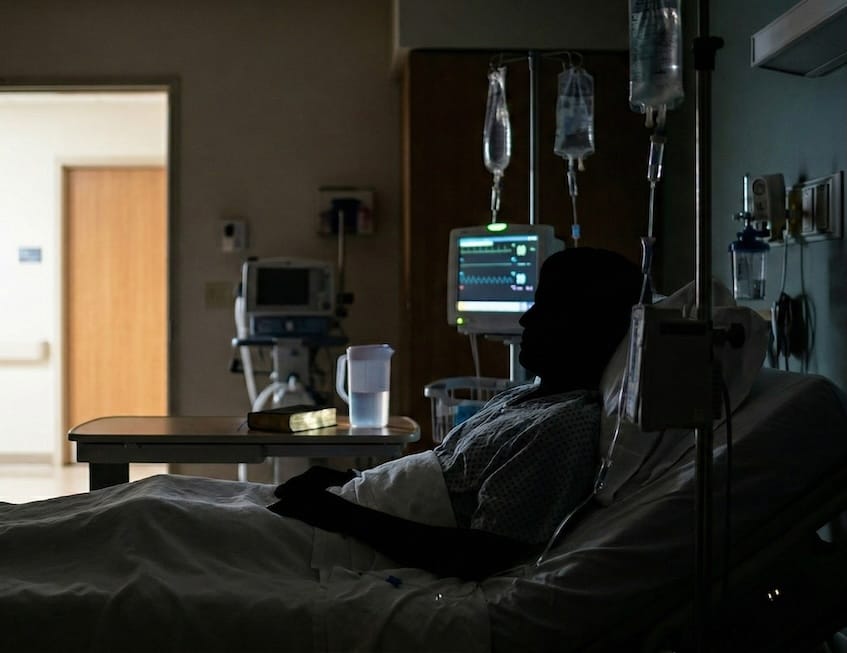
For over 25 years, I have walked into hospital rooms to care for the sick. I have sat at bedsides, delivered hard news, and prayed with frightened patients. Three weeks ago, I was the one in the bed.
After four days of spiking fevers, chills, and severe pain in my left hip and thigh, I asked my wife to drive me to the emergency room. I was not responding to oral antivirals and antibiotics, and I knew something was wrong. Within hours, I learned I had four simultaneous diagnoses — two of them life-threatening. Over the next five days, I lay confined to a hospital bed, receiving nonstop IV medications and imaging scans, the patient I had never imagined I would be.
Lying in that hospital bed, I had nowhere to go and nothing to do but think, pray, and listen. I could not work. I could not study. I could not serve anyone. For the first time in a long time, I was completely still, and God had my full attention. Here are five lessons He taught me.
1. Affliction Is a Classroom.
You are good and do good;
Teach me Your statutes.
It is good for me that I was afflicted,
That I may learn Your statutes. (Ps. 119:68, 71)
The Psalmist makes a striking declaration: affliction is good. Not merely tolerable, not something God permits reluctantly, but good. Why? Because God, who is Himself good, uses suffering as a classroom. He employs pain, limitation, and loss as instruments of instruction that prosperity cannot provide.
I have sat under sound expository preaching for over three decades. I spent four years in seminary. I have read countless books on the Bible and the Christian life. But there are some lessons that cannot be learned from a pulpit, a classroom, or a page. They can only be learned in the classroom called affliction.
Lying in that hospital bed, I was not reading a commentary or sitting in a lecture hall. I was weak, dependent, and afraid. But God was teaching me things I could not have learned any other way. Affliction is not a detour from God's purposes; it is His purpose. And for that, even now, I am grateful.
2. Our Days Are Numbered.
Lord, make me aware of my end and the number of my days so that I will know how short-lived I am. (Ps. 39:4, CSB)
The Psalmist is not asking God to tell him the exact date of his death. He is asking for the awareness of his mortality, because that awareness is itself a form of wisdom. We do not naturally think this way. We spend most of our lives acting as though the future is ours to plan and keep. But the man who knows his days are numbered lives differently. He holds his time loosely. He wastes less of it. He gives more of it away.
Like most people, I had quietly assumed I would live into my seventies or eighties. I had no chronic conditions and took no medications. Death was something I thought about theologically but not personally. Then I learned that this illness had taken more than half of my kidney function. It took losing half my kidney function to see what the Psalmist already knew: life is not a possession. It is a loan. A morning without pain, a meal at my own table, an evening with my family — these are graces I once received without thought, like a child who tears open a present without pausing to consider the giver. Now I pause. God has already ordained the number of my days. What remains is mine to steward. I want to spend those days well, not merely to live longer, but to live for Him.
3. God Is So Good.
O taste and see that Yahweh is good;
How blessed is the man who takes refuge in Him! (Ps. 34:8)
The best Texas barbecue cannot be fully described. It can only be tasted. You can read every review, study every recipe, and hear every pitmaster explain his craft, yet still know nothing of what it is to bite into perfectly smoked brisket for the first time. The Psalmist understood this about God. Taste and see. Not study and conclude, not observe and acknowledge, but taste. The goodness of God is not a proposition to be accepted. It is a reality to be experienced, and affliction, I discovered, is one of the places where that goodness becomes most vivid.
I thought I understood God's goodness before that week. I did not.
On the evening I was most ill, burning with fever and shaking with chills, my hip and thigh gripped by pain, I found one position in that hospital bed where the pain eased enough to breathe. And lying there in the dark, alone and helpless, I stopped fighting it. It was just me and God. Tears I could not explain streamed down my face.
For the next hour, I found refuge in Him in a way I never had before. I have no better words for it: it was the sweetest experience of my life. In that moment, I understood something no pulpit or page had taught me. One hour communing with God in a hospital bed is better than a lifetime of health spent without Him. If you have not yet tasted His goodness, I pray that you will. And I pray it does not take a hospital bed to get you there.
4. God's Comfort Flows Outward.
Blessed be the God and Father of our Lord Jesus Christ, the Father of mercies and God of all comfort, who comforts us in all our affliction so that we will be able to comfort those who are in any affliction with the comfort with which we ourselves are comforted by God. (2 Cor. 1:3–4)
Paul is describing a chain of grace. God comforts us in our suffering, and that comfort was never meant to stop with us. It flows outward. The person who has wept in a hospital bed knows something the healthy visitor does not. The one who has lain awake at three in the morning, unable to sleep, unable to pray anything more than a single word, can sit with another frightened person in a way that no textbook or seminary course can teach. Affliction, received with open hands, does not just change us. It equips us.
Over the past three weeks, friends and church members met me with meals left at our doorstep, handwritten cards, and words I will not easily forget. My wife and children gathered around me those first evenings home. They prayed for me during family worship, and their voices carried more comfort than they knew. But I noticed something. The ones who sat with me most naturally, who knew exactly what to say and when to say nothing, were almost always people who had walked through their own season of suffering. They did not arrive with rehearsed encouragement. They arrived with hard-won comfort. I recognized what they were doing because only days earlier, I had lain alone in a dark hospital room, receiving a comfort I could not manufacture and did not deserve. They were not simply being kind. They were links in the chain Paul describes.
Lying in that hospital bed, I made a commitment. If God restored my health, I would become a more compassionate physician. I have sat across from thousands of patients over the years, listening to their symptoms and developing their treatment plans. But I have not always fully entered their fear. I know now what it is to lie helpless, dependent on medications and the hands of others. I know what it is to need someone to simply sit with you. That knowledge is a gift I did not ask for and would not have chosen. But it is mine now, and I intend to pass it along. Your suffering has equipped you with something too. Do not let that comfort stop with you.
5. Jesus Really Cares.
For we do not have a high priest who cannot sympathize with our weaknesses, but One who has been tempted in all things like we are, yet without sin. (Heb. 4:15)
My five days in the hospital were the most physically painful of my life. Yet they were a shadow, a whisper, of what Jesus endured. I did not choose my suffering. He chose His. He took on human flesh voluntarily, lived among the sick and sorrowing, and walked willingly toward a cross where He bore the full weight of sin and judgment as a substitute for His people. He did not observe human suffering from a distance. He entered it completely. And because He did, we do not approach God as a distant deity unmoved by our pain. We come to Jesus, the Son of God, who knows and cares.
Jesus is not a High Priest who reviews our files from a safe distance. He walked through hunger, exhaustion, grief, and betrayal. He wept at a tomb. He sweated drops of blood in a garden, dreading what was coming. He knows what it is to suffer, not theoretically but personally. And because He passed through suffering without sin, He is uniquely qualified to intercede for us in ours. When we cry out from a hospital bed, from a sleepless night, from a season of loss, we are not crying into an empty room. We cry to One who has been there. And He holds us in a grip that neither sickness nor death can break.
Affliction is a classroom. Our days are numbered. God is good, and His comfort flows outward. Jesus really cares. These are not lessons I learned from a textbook. They were taught to me in a hospital bed I never expected to occupy.
I continue to regain my strength, but I walk differently. I listen longer. I sit closer. I pray with less formality and more urgency. I am still a physician, but I am also a former patient, and that changes everything.
My kidney function may never fully recover. My future health is uncertain. But the God who taught me in that hospital bed is the same God who holds every one of my remaining days. Whatever days remain, they belong to Him. And that is more than enough.
Therefore we do not lose heart, but though our outer man is decaying, yet our inner man is being renewed day by day. For our momentary, light affliction is working out for us an eternal weight of glory far beyond all comparison. (2 Cor. 4:16–17)


